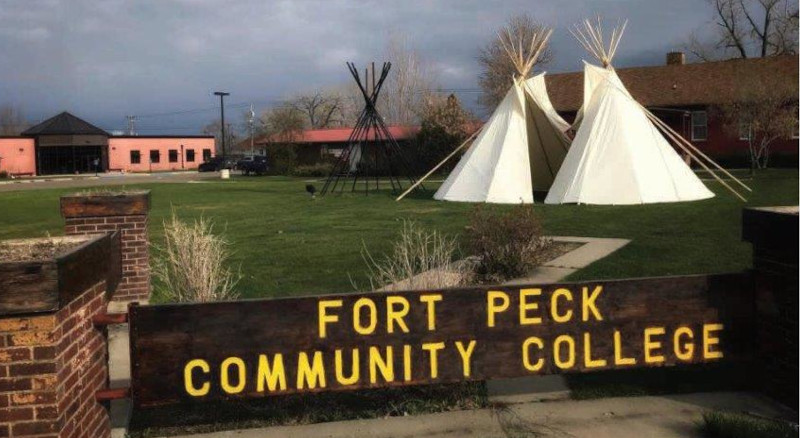
Healthcare and government working are the primary employers of people in the community, and the local college is aiming to cater to these needs.
Fort Peck Community College’s calendar states final grades were due December 16, 2024, bringing the Fall 2024 Semester to an end. Classes are scheduled to resume January 13, 2025.
Fort Peck Community College has done a lot for the community but can do so much more, according to a workforce development report.
During the Tribal Council’s Education Committee meeting in November, new FPCC President Craig Smith presented a report from the college to the council. The report outlines statistics from the college, focusing on developing a workforce on the reservation and surrounding communities.
The report was compiled by FPCC and Latta Consultants, a marketing and media consulting agency out of Bozeman, to conduct a community needs assessment. It is intended to provide insight and guides for secondary education through FPCC.
Education
According to the report, Associate of Arts degree programs have the highest student enrollment, with the highest demand being in General Studies, Business Administration, Chemical Addiction Studies, and Education.
Non-degree seeking students, including those enrolled in dual credit or early college courses, make up the second highest number of FPCC students, the report states.
Certificates enrollment is also popular, particularly in Business Technology, Cultural Arts, Lay Advocate, and Information Technology.
Community interests and needs for future classes suggested include courses related in trade related training (carpentry, auto mechanics, etc.); healthcare with a focus on mental health and addiction treatment; business and professional related skills/training’s; American Indian arts and culture related courses, and finally life skills courses and activities.
Unfulfilled job listings in the area are also diverse, recent unfulfilled job listings include position in criminal justice, health care, education including early childhood education, trades and skilled laborers, service industry workers, tribal administration, agriculture related positions including equipment operators, and general laborers.
As for the retention problem, the report states existing employment is prospective student’s biggest barrier for attending classes. Of this, 55 percent of respondents say class conflicts with work hours, 34 percent say they need financial assistance, and 18 percent say they need help with child care.
Survey
Based on a survey, seven out of 10 respondents believe FPCC is meeting the community interests and needs.
However, there were some that were concerned that FPCC could is not meeting the needs of the community. These respondents said they wanted more communication from the college as well as more community input as to what is offered at FPCC. They also wanted to see different courses and activities being offered relevant to the needs of the community.
The report also states the different needs of the students can vary depending on age, economic circumstances, and future plans. These factors include students who are struggling and may need basic skills in addition to the FPCC curriculum, and they may not know what to pursue; some have multiple interests and have more skills/motivation than others/ and some may be more interested in personal improvement than employment.
Overall, the community has a positive opinion of FPCC. Majority of survey respondents
Needs
So what does FPCC need to offer to meet future needs?
The report states the college will need to build collaborations with the Tribes, the Great Northern Development Corporation, the Wolf Point Job Service office, local high schools, and the largest employers in the area as well as others in the region who are focused on economic development and workforce development to determine what is needed.
With the ongoing challenges of recruiting and retaining employees who aren’t from the region, there is also an important opportunity for the college to work with community leaders and stakeholders to “grow the area’s own workforce,” the report states.
To keep up with the evolving wants and needs of the region, the college will need to continue to tap existing educational resources to offer additional educational opportunities, maybe even possibly offering certain specialized certificates for a limited time, according to the report.
Workforce Where?
Data from the Montana Department of Labor and Industry outlines job projections from 2022 to 2032 in Eastern Montana. Among the top 30 occupations projected to have the most annual openings, at least 12 require more than a high school diploma or GED, and others will benefit from certificates, licenses and/or trade school. Eight require a bachelor’s degree, two require some college, no degree, and two require post secondary education, no degree.
Of this, the highest in demand is heavy and tractor-trailer truck drivers, 118 openings; home health and personal care aides, 109 openings; general office clerks, 87 openings; stockers and order fillers, 82 openings; bookkeeping, accounting and auditing clerks, 77 openings; all other managers, 55 openings; general and operations managers, 50 positions; light truck drivers, 49 positions; teaching assistants (except post-secondary), 47 openings; and secretaries and administrative assistants (with the exception being legal/medical), 39 positions.
Other positions include elementary school teachers (except special ed teachers), childcare workers, operating engineers and other construction equipment operators, maintenance and repair workers, registered nurses, carpenters, secondary school teachers (except special and career) customer service representatives, accountants and auditors, bust drivers, court clerks, first line supervisors of mechanics and installers, medical secretaries and administrative assistants, police and sheriff’s patrol officers, electricians, automotive service technicians and mechanics, first line supervisors or transportation and material, medical and health service managers, industrial machinery mechanics and business operations specialists.
Regional Needs
The are five major areas of need by the community for future workers, leaders, and citizens. This would require the workforce to have a variety of skills including educational proficiency in math, spelling, etc.; basic life skills such as managing personal finances, using technology, cooking, cleaning, etc.; professional or soft skills including how to apply for a job, communication, teamwork, decision-making, time management, leadership, public speaking, adaptability, etc.; customer service skills such as active listening, problem-solving, etc.; and community engagement which includes things like volunteer work.
Employability
Majority of the students surveyed feel prepared. Approximately 81 percent of students feel prepared based on what they learned at FPCC. Frequently noted themes as to why they felt prepared included learning what they needed to succeed, benefiting from the guidance of the faculty and staff, acquired confidence and determination, the education was applicable to their degree, job, and lives.
The community is less likely to believe FPCC students are prepared, according to the report. Of all community members surveyed, 61 percent believed FPCC students are prepared. Majority, 77 percent, would consider hiring FPCC students after graduation and 68 percent also believe FPCC students are employable.




Leave a Reply