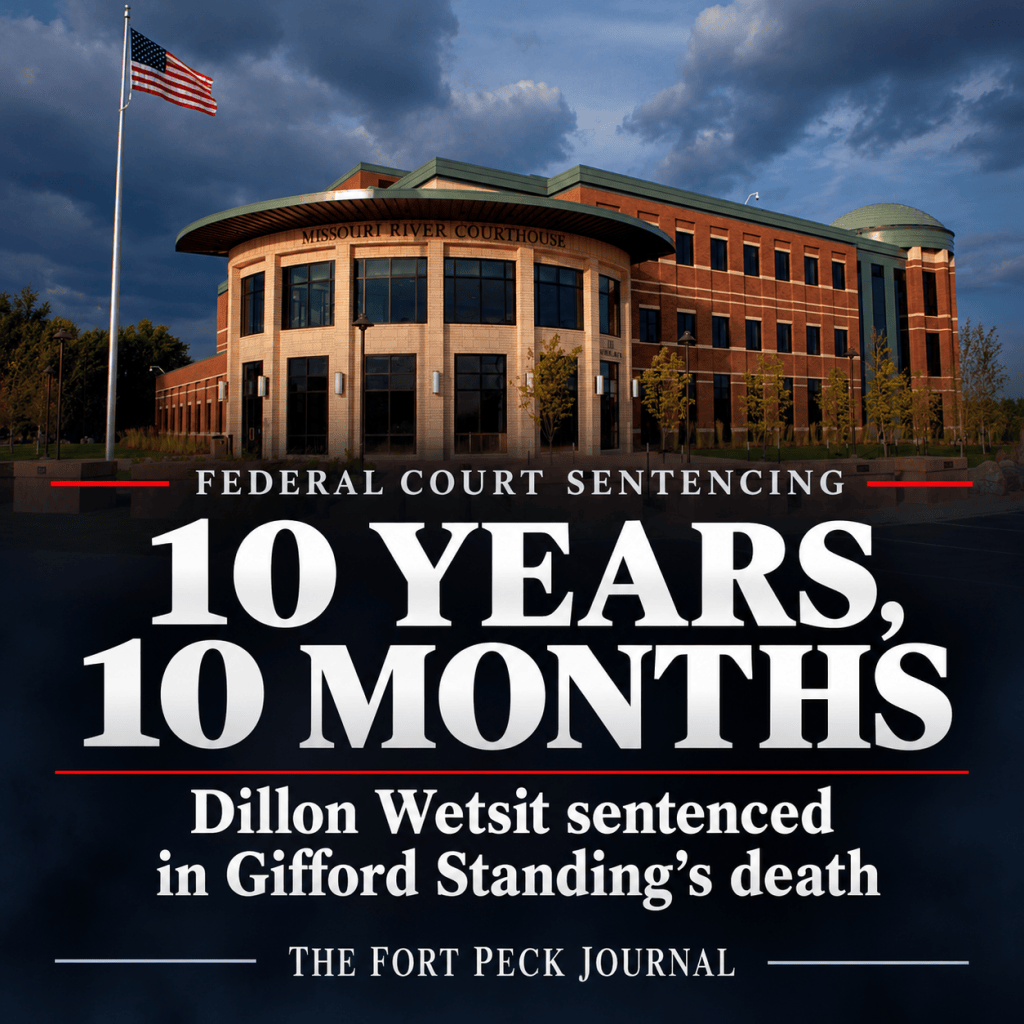
Three defendants now sentenced to federal prison in 2025 Wolf Point homicide
GREAT FALLS — A third defendant has been sentenced to more than a decade in federal prison for his role in the brutal beating death of Wolf Point resident Gifford Standing, bringing another major development in a homicide case that began with four arrests and murder charges in Fort Peck Tribal Court more than a year and a half ago.
Dillon Demery Wetsit, 38, of Wolf Point, was sentenced Wednesday, Oct. 28, to 10 years and 10 months in federal prison, followed by three years of supervised release, according to the U.S. Attorney’s Office for the District of Montana.
Wetsit pleaded guilty to voluntary manslaughter in June 2026. Chief U.S. District Judge Brian M. Morris imposed the sentence in Great Falls.
Wetsit is the third person to receive a federal prison sentence in connection with Standing’s death. Calvin Florin Lester, 37, was sentenced Sept. 3 to 10 years and 10 months in prison, while Abrianne Lillian Deserly, 26, received a sentence of 11 years and four months on Sept. 14.
All three defendants pleaded guilty to voluntary manslaughter and received an additional three years of supervised release.
The sentences conclude the federal sentencing proceedings for the three defendants identified in the U.S. Attorney’s Office announcements concerning Standing’s death.
A violent death in Wolf Point
Standing, 48, was discovered dead Feb. 26, 2025, on the second floor of an abandoned building at or near 204 First Avenue South in Wolf Point.
Federal prosecutors described the building as a place where people occasionally gathered to drink alcohol and sleep.
According to the U.S. Attorney’s Office, Wetsit, Lester and Deserly had been drinking before entering the building during the early morning hours of Feb. 26. The three found Standing asleep on the second floor.
An argument broke out, and the confrontation escalated into a violent assault.
Prosecutors said all three defendants began striking Standing. As the attack continued, the beating became increasingly severe. At one point, Standing was placed in a chokehold while members of the group continued hitting him.
A medical examination determined Standing died from homicidal violence involving compression of his neck and blunt-force injuries to his head.
His body was discovered later that day.
The location had already been associated with another death. Months earlier, Stan Moran, 49, had died in a fire inside the same building. The two deaths were separate incidents.
Four originally arrested in homicide investigation
The Fort Peck Journal began covering Standing’s death shortly after his body was discovered, as law enforcement worked to identify those responsible.
Within days, tribal and federal investigators had taken four individuals into custody: Deserly, Lester, Wetsit and Michael Menz.
Initially, some defendants were held on unrelated tribal charges while the homicide investigation continued.
Wetsit appeared in Fort Peck Tribal Court on a charge of violating a restraining order. He pleaded guilty and was sentenced to six months in jail, with three months suspended.
Deserly also appeared in Tribal Court on a driving under the influence charge. She pleaded guilty and received a 45-day sentence.
Formal homicide charges followed.
During a special arraignment in Fort Peck Tribal Court, all four defendants appeared before Judge Lonnie Headdress. Tribal prosecutors Adrienne Weinberger and Holly Denny represented the Tribes, while Tribal Public Defender Terry Boyd Sr. was also present.
Deserly and Lester were charged with murder. Wetsit and Menz were charged with complicity to murder.
All four pleaded not guilty.
Prosecutors argued that the seriousness of the alleged crime, concerns for public safety and the possibility that the defendants could flee justified keeping them in custody.
Judge Headdress agreed and ordered all four remanded into tribal custody pending further proceedings.
Original court documents detailed the attack
The original tribal criminal complaints provided some of the earliest detailed allegations about what happened inside the abandoned building.
According to those documents, the fatal assault occurred between approximately 1 a.m. and 3 a.m. Feb. 26, 2025.
Tribal prosecutors alleged Deserly repeatedly punched and kicked Standing in the head and face while Lester placed him in a chokehold and physically assaulted him.
The complaint alleged that the beating continued after Standing was knocked to the ground.
At the time, Wetsit and Menz were accused of being present during the killing and failing to intervene, seek assistance or report what had occurred.
Prosecutors alleged their inaction helped facilitate the crime.
The original complaint also accused Menz of urinating on Standing’s body following the fatal assault.
Those allegations formed the basis of the initial tribal charges and were not themselves findings of guilt.
The federal government’s later account differed in an important respect. Federal prosecutors identified Wetsit as an active participant in the beating alongside Lester and Deserly, rather than someone whose alleged involvement was limited to failing to intervene.
All three ultimately admitted criminal responsibility by pleading guilty to voluntary manslaughter.
Menz was not identified as one of the three defendants sentenced in the federal proceedings. The federal announcements do not explain the final disposition of his original tribal charges.
Case moves into federal court
The homicide investigation eventually led to federal prosecution.
On April 29, 2025, Lester and Deserly appeared in U.S. District Court in Great Falls on charges of second-degree murder. Both initially pleaded not guilty.
At the time, the federal murder charges carried a potential maximum sentence of life imprisonment.
The case subsequently moved through federal pretrial proceedings before the defendants entered guilty pleas to the lesser offense of voluntary manslaughter.
During the federal proceedings, Deserly’s defense challenged the handling of certain evidence collected, lost or left behind during the investigation.
Among the evidence questioned were boots belonging to Wetsit that had been cut off during his booking into tribal custody and subsequently discarded, along with a metal pipe and blood evidence from the crime scene.
The defense argued that the missing evidence could have been relevant to determining who inflicted Standing’s fatal injuries.
In a March 13, 2026, order, Chief Judge Morris denied a defense motion seeking dismissal of Deserly’s indictment.
Although the court acknowledged concerns about the handling of evidence, the judge determined that the record did not establish the bad faith required to dismiss the case on those grounds.
The case ultimately ended in guilty pleas rather than a trial.
Lester pleaded guilty to voluntary manslaughter in May 2026, Wetsit entered his plea in June, and Deserly pleaded guilty before her September sentencing.
Three federal prison sentences
The first federal sentence was handed down Sept. 3 when Lester received 10 years and 10 months in prison.
Less than two weeks later, on Sept. 14, Deserly was sentenced to 11 years and four months, the longest of the three prison terms.
Wetsit’s sentencing on Oct. 28 resulted in the same prison term imposed on Lester: 10 years and 10 months.
Each defendant was also sentenced to three years of supervised release following imprisonment.
The three prison terms total 33 years, although each sentence is imposed separately and the defendants will serve their respective terms independently.
The convictions and sentences mark a significant change from the case’s beginnings, when Lester and Deserly faced murder charges in both tribal and federal proceedings and Wetsit was initially charged in Tribal Court with complicity to murder.
Killing prompted community protest
Standing’s death shocked Wolf Point and generated widespread anger over violence in the community.
On March 2, 2025, approximately 30 people participated in a Stop the Violence demonstration in downtown Wolf Point.
Community members carried signs and marched along the town’s main streets, calling attention to Standing’s killing and other acts of violence that had affected local families.
The demonstration took place as tribal and federal authorities continued investigating Standing’s death.
The Fort Peck Tribes Criminal Investigation Division and the FBI conducted the investigation that ultimately resulted in the federal prosecutions.
The U.S. Attorney’s Office for the District of Montana prosecuted the case.
With Wetsit’s sentencing, three people have now received federal prison terms of more than 10 years each for their involvement in the killing of Gifford Standing, whose death in February 2025 prompted an investigation that stretched from Fort Peck Tribal Court to the federal courthouse in Great Falls.




Leave a Reply