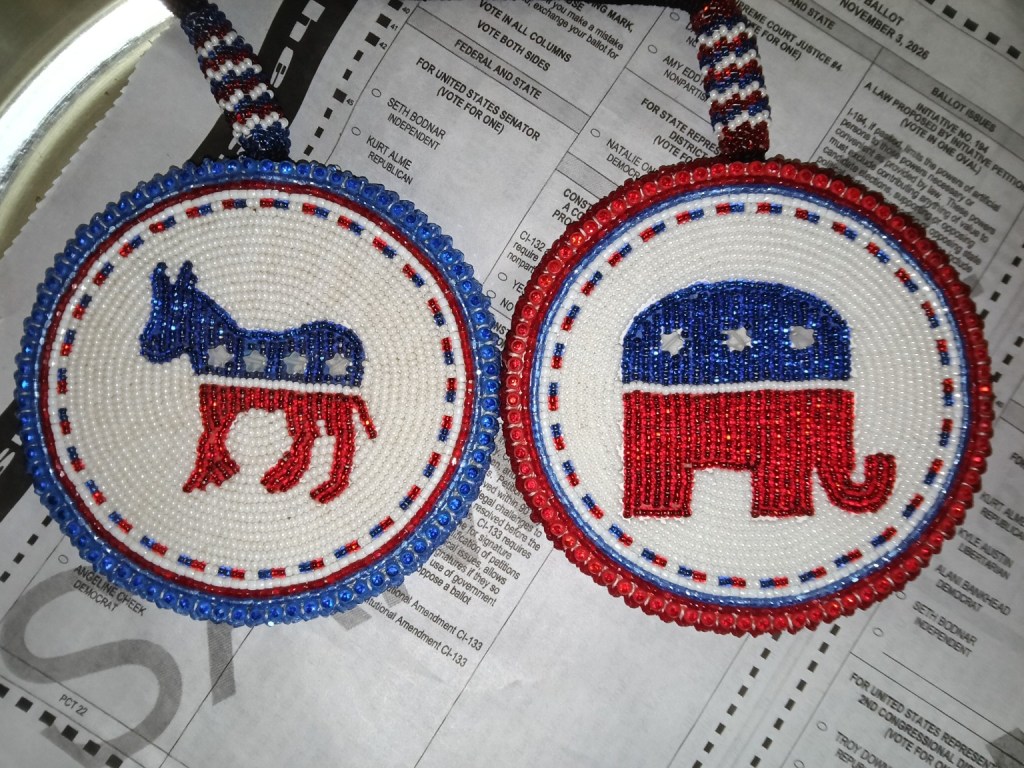
Federal races, state legislative seats, three ballot initiatives and a Public Service Commission contest will be decided November 3
FORT PECK — Voters across Montana will head to the polls Tuesday, November 3, for the 2026 general election, with federal, state and local races on the ballot, along with three statewide initiatives that could change Montana’s Constitution and election laws.
For voters on the Fort Peck Reservation, the election includes contests for the United States Senate, U.S. House of Representatives, Montana Supreme Court, Public Service Commission and Montana House of Representatives.
However, several Roosevelt County offices that were originally scheduled for election will not appear as contested races after county commissioners canceled the elections because the candidates were running unopposed.
The following is a breakdown of the races and issues facing voters in Roosevelt County and the surrounding Fort Peck area.
United States Senate
Montana voters will elect a new United States senator to replace Republican Steve Daines, who is not seeking another term.
Four candidates will appear on the ballot: Republican Kurt Alme, Democrat Alani Bankhead, Libertarian Kyle Austin and Independent Seth Bodnar.
Jami Dee Woodman is also a registered write-in candidate.
The winner will serve a six-year term in the United States Senate, representing Montana in Congress on matters involving federal legislation, spending, judicial confirmations and other national issues.
The Senate race is one of the major statewide contests in this year’s election, with no incumbent seeking reelection.
United States House of Representatives
Voters in eastern Montana, including the Fort Peck Reservation, will select a representative for Montana’s Second Congressional District.
Republican incumbent Troy Downing is seeking another term against Democrat Brian J. Miller, Libertarian Patrick McCracken and Independent Michael D. Eisenhauer.
The winner will serve a two-year term in the U.S. House of Representatives.
Montana’s Second Congressional District covers much of central and eastern Montana, including the communities of Poplar, Wolf Point, Brockton, Culbertson and Glasgow.
Montana Public Service Commission
One of the races with a direct connection to the Fort Peck Reservation is for Montana Public Service Commission District 1.
Democrat Angeline Cheek of Brockton is running against Republican Jeff Pattison of Glasgow.
Cheek has a background in Indigenous advocacy and community organizing, while Pattison is a farmer, rancher, business owner and former Montana state legislator.
The Public Service Commission is responsible for regulating certain utility companies that provide electricity, natural gas and other services to Montana residents.
Commissioners review utility rate requests and other matters that can affect monthly bills paid by households and businesses.
Energy affordability, utility oversight and the potential impacts of large data centers on electricity rates have been among the issues discussed during the District 1 campaign.
The race gives voters in northeastern Montana an opportunity to select a representative on the commission that oversees several essential utility services.
Montana Supreme Court
Voters will also select a justice for the Montana Supreme Court.
The candidates are Amy Eddy and Dan Wilson, both district court judges from Flathead County.
The election is nonpartisan, meaning the candidates do not appear on the ballot with political party affiliations.
The winner will fill the seat currently held by Justice Beth Baker.
The Montana Supreme Court is the state’s highest court and reviews cases involving constitutional questions, criminal law, civil disputes and other legal matters.
Its decisions can affect state laws and the operation of courts throughout Montana.
Montana House of Representatives
All 100 seats in the Montana House of Representatives are up for election this year.
For much of the Fort Peck Reservation, including Poplar, Wolf Point and Brockton, the relevant legislative race is House District 31.
Democrat Natalie O’Neal is running unopposed for the district following her victory in the June primary election.
Other portions of Roosevelt County fall into neighboring legislative districts.
In House District 29, Republican incumbent Valerie Moore is being challenged by Democrat Tess Fahlgren.
In House District 30, Republican incumbent Morgan Thiel is facing Democrat Jason Boeshore.
The House District 29 race appears on ballots in portions of Roosevelt County precincts 2, 10, 12, 17 and 28. Some voters in precincts 2 and 12 are instead assigned to House District 30.
Voters should check their assigned legislative district to determine which candidates will appear on their ballots.
Montana senators serve four-year terms, and Senate District 16, which includes Poplar and Wolf Point, is not scheduled for election this year. State Senator Jonathan Windy Boy continues serving his existing term.
Roosevelt County Elections Canceled
Seven Roosevelt County offices will not be decided through contested elections on November 3.
During their August 18 meeting, Roosevelt County commissioners canceled certain local government elections because each office had only one candidate seeking election.
The candidates were subsequently declared elected by acclamation, meaning they were elected without a general election vote for those offices.
The candidates declared elected were Gordon Oelkers for county commissioner, Tracy Miranda for clerk and recorder, Thomas Bleicher for county attorney, Marvin Youpee for justice of the peace in Post 1, Tara Nickoloff for justice of the peace in Post 2, Jason Baker for sheriff and Betty Romo for county treasurer.
The decision means Roosevelt County voters will not see a contested sheriff’s race or the other canceled county races on Tuesday’s ballot.
Federal, state, judicial and other applicable elections will continue as scheduled.
Three Statewide Ballot Initiatives
In addition to selecting candidates, Montana voters will decide three statewide ballot initiatives.
Two would amend the Montana Constitution, while a third would establish a new state law concerning political spending by corporations and other organizations.
Constitutional Initiative 132 — Nonpartisan Judicial Elections
CI-132 would amend the Montana Constitution to require that judicial elections remain nonpartisan.
Montana currently conducts nonpartisan judicial elections, but the proposal would place that requirement directly into the state Constitution.
A vote in favor would establish the constitutional requirement. A vote against would leave the Constitution unchanged.
Constitutional Initiative 133 — Initiative and Referendum Rights
CI-133 concerns the ability of Montana residents to propose laws and constitutional amendments through the initiative and referendum process.
The proposal would add protections for those powers to the Montana Constitution’s Declaration of Rights.
It would also establish requirements intended to make the initiative process impartial, predictable and timely.
Among its provisions are protections against disqualifying petitions for minor technical mistakes, requirements involving the review of ballot petitions and procedures for verifying signatures.
A vote in favor would adopt the constitutional changes, while a vote against would leave the current constitutional provisions in place.
Initiative 194 — Political Spending by Corporations and Organizations
I-194 would establish restrictions on political contributions and spending by certain organizations defined in the proposal as “artificial persons.”
These include corporations, nonprofit organizations, partnerships, trusts, trade associations and other covered entities doing business in Montana.
The measure would prohibit these organizations from contributing anything of value to candidate elections or supporting or opposing political parties and state or local ballot initiatives.
Organizations violating the law could lose their privileges to conduct business in Montana, subject to the measure’s provisions for restoring those privileges.
The measure includes exceptions for individuals, political committees, government entities and the distribution of news, commentary or editorial content.
A vote in favor would enact the proposed restrictions into state law, while a vote against would leave the law unchanged.
Unlike the two constitutional initiatives, I-194 would be a state statute rather than an amendment to the Montana Constitution.
Where to Vote
Polling places across Montana will be open Tuesday, November 3.
Most polling locations open at 7 a.m. and close at 8 p.m. Smaller polling places serving fewer than 400 registered polling-place voters may open later but must open no later than noon.
Roosevelt County voting locations include Poplar Middle School for precincts 16 and 18, the Brockton School District Office for precinct 15, and Faith Free Lutheran Church in the Brockton area for precinct 17.
Wolf Point voters assigned to precincts 22, 24, 26, 27 and 28 have been directed to the Wolf Point Senior Citizens Center.
Other listed locations include Bainville School for precinct 2, Froid Community Center for precinct 10 and Culbertson School for precinct 12.
Voters should verify their assigned polling location before Election Day because voting sites are determined by precinct.
Montana voters are required to provide acceptable identification when voting. Voters who do not have the required identification should contact election officials about available alternatives.
Absentee ballots must be received by election officials no later than 8 p.m. on Election Day. Mailing a ballot on Tuesday does not guarantee it will arrive before the deadline.
Residents can check their voter registration information and assigned polling locations through the Montana Secretary of State’s voter portal at voterportal.mt.gov.
Voters needing assistance with registration, ballot questions or polling locations can also contact the Roosevelt County Election Office in Wolf Point.
The election will determine who represents northeastern Montana in Congress and state government, who serves on the Public Service Commission and Montana Supreme Court, and whether three proposed changes to Montana law and its Constitution are adopted.
Election Day is Tuesday, November 3. Polls close at 8 p.m.
The Fort Peck Journal encourages all eligible voters to review their ballots, verify their polling locations and participate in the election.




Leave a Reply