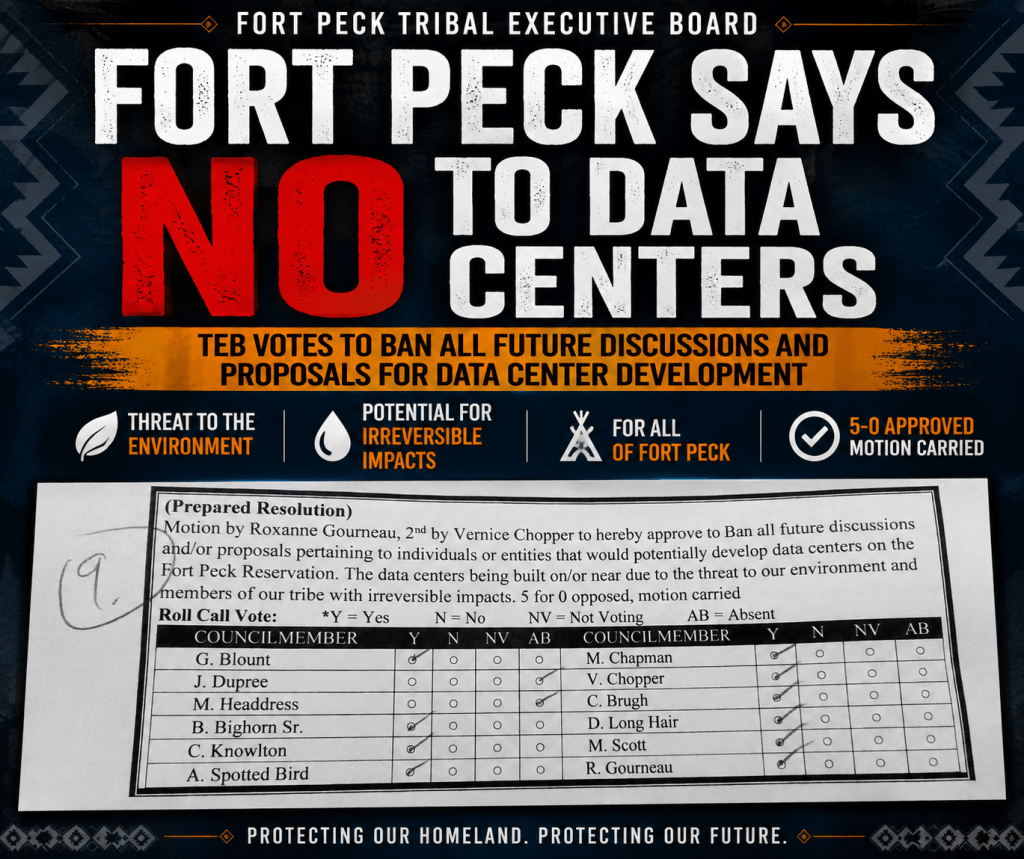
Council members cite environmental concerns and potential irreversible impacts; no member present opposed the measure
The Fort Peck Tribal Executive Board has taken a sweeping position against data center development on the Fort Peck Reservation, approving a measure intended to stop future discussions and proposals for such facilities anywhere on Fort Peck.
The prepared resolution, moved by Councilwoman Roxanne Gourneau and seconded by Councilwoman Vernice Chopper, calls for the TEB to “Ban all future discussions and/or proposals” involving individuals or entities that could potentially develop data centers on the Fort Peck Reservation.
The resolution cites threats to the environment and the potential for irreversible impacts on tribal members as the reason for the action.
While discussion of the motion was brief, council members clarified an important point before voting: the prohibition is intended to cover all of Fort Peck.
Councilwoman Marva Chapman asked whether the measure applied to the entire reservation and whether a developer could circumvent the restriction by locating a data center on fee land.
Chairman Floyd Azure responded that the measure was for all of Fort Peck.
No further substantial discussion followed before the board voted. Ten council members voted in favor, with none opposed. Councilmembers Jestin Dupree and Mike Headdress were absent.
The action represents a notably broad rejection of data center development. Rather than opposing a particular company, location or proposed facility, the language seeks to end future consideration of data center proposals generally.
Why data centers are raising concerns
Data centers house large amounts of computer equipment used for services ranging from internet and cloud computing to artificial intelligence and cryptocurrency operations.
Their environmental footprint varies significantly depending on the facility, but very large data centers can require extraordinary amounts of electricity. Some also require significant quantities of water for cooling, while associated impacts can include new electrical infrastructure, noise from cooling systems, emissions from backup generators and the physical footprint of large industrial developments.
Those concerns have grown as increasingly large facilities have been proposed and constructed throughout the United States.
Fort Peck does not have to look far to find an example.
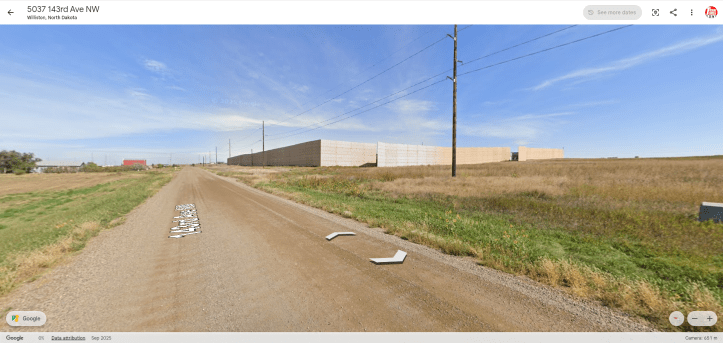
Massive facility operates near Williston
The Atlas Power Data Center near Williston, North Dakota, was announced in 2022 as a $1.9 billion development that could eventually reach approximately 700 megawatts of electrical capacity.
At the time, North Dakota officials described the project as one of the largest data center developments in the world. The project was expected to create more than 100 construction jobs but approximately 30 permanent jobs once operational.
The facility later became part of a broader North Dakota discussion about the enormous electrical demands created by data centers.
North Dakota Public Service Commission Chairman Randy Christmann pointed to the Williston facility in 2024 while discussing transmission costs associated with large electrical loads. Christmann said the facility contributed to transmission expenses borne by Montana-Dakota Utilities customers and questioned whether Williston had been the appropriate location for such a large electrical load.
The Williston area is also seeing additional data center development, demonstrating how quickly the industry is expanding in the region.
Fort Peck draws a line
Fort Peck’s action goes considerably further than evaluating those potential costs against the benefits of an individual development.
The board’s prepared resolution seeks to prevent future data center proposals from being entertained in the first place.
Chapman’s question concerning fee land also established the council’s stated intent that developers should not be able to avoid the restriction simply by selecting a different type of property within reservation boundaries.
Whether and how that policy could be enforced on every category of fee land may involve separate jurisdictional questions. However, the position expressed by tribal leadership during the meeting was clear: the measure is intended to apply throughout Fort Peck.
With ten members voting in favor, two absent and none opposed, the Tribal Executive Board drew an unusually firm line on the issue.
For Fort Peck, data center development is off the table.




Leave a Reply