CARLISLE, Pa. — Rain fell over Carlisle the night before Christine Redstone was removed from the cemetery where she had rested for 127 years.
National Weather Service records show Carlisle received 0.33 inches of precipitation during the 24-hour period ending Wednesday morning. Michael Redstone, a living descendant of Christine who witnessed the Sept. 2 disinterment, said the overnight rain softened the ground and helped the crew complete its work quickly.
“It went okay. It rained last night, so it made the ground soft,” Michael said. “They were able to work pretty quickly.”
When asked what the moment felt like, Michael’s answer was simple.
“It was a relief,” she said. “The hardest part was done.”
Christine was the third of three Fort Peck children disinterred from the Carlisle Barracks Main Post Cemetery this week. Peter Howe and Richard Morgan were disinterred Tuesday, Sept. 1. An Inipi ceremony was held afterward. Work resumed Wednesday with Christine.
All three were taken from the Fort Peck Reservation as children and sent more than 1,600 miles away to the Carlisle Indian Industrial School in Pennsylvania. All three died before they could return home.
The moment they reached Christine
Michael said the excavation crew paused when it reached the box containing Christine’s remains.
“Yes, I was there,” she said. “They stopped digging and let us know they reached her box. They took pictures to document it was indeed the box. And then they continued excavation.”
Once the disinterment was complete, the crew photographed the empty grave to document that Christine’s remains had been fully removed.
“They told me it was complete, and there was nothing more to do but wait for the next step, which is the forensic analysis,” Michael said.
The family requested the box that will carry Christine home and prepared it for her with care and prayer. Michael did not disclose details of the preparation, explaining only: “We did all the things that you do for a traditional Assiniboine burial.”
Those details will remain with the family.
The examination scheduled for Sept. 3 and 4 is intended to confirm and document the remains before they are formally transferred to the Fort Peck delegation. Officials have described the process as forensic analysis; no announcement has been made that it includes DNA testing.
From Poplar Creek to Carlisle
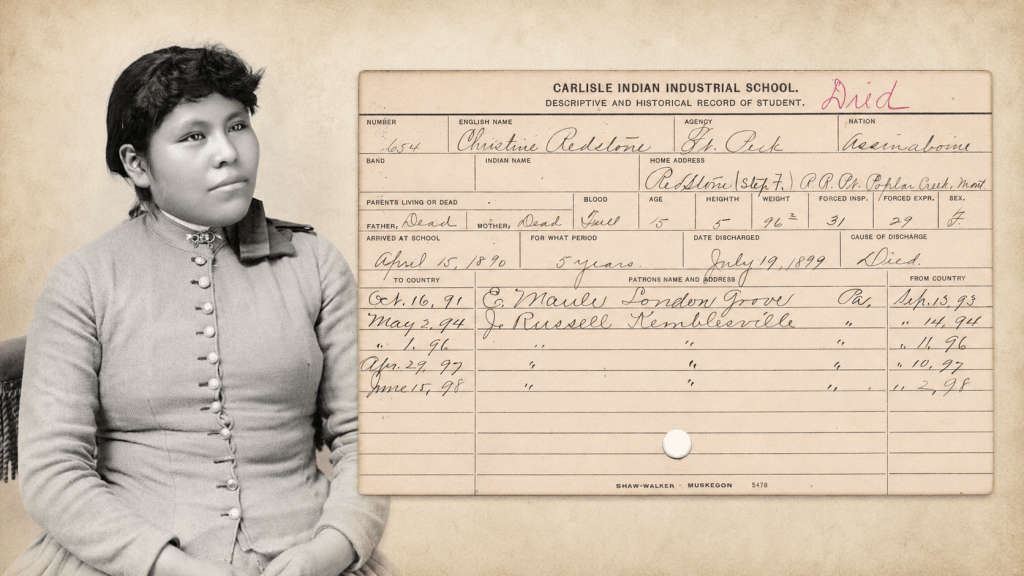
Carlisle’s records identify Christine as an Assiniboine girl from Poplar Creek, Montana. She entered the school on April 15, 1890, at approximately 15 years old—the same day Peter Howe and Richard Morgan arrived from the Fort Peck Agency.
One of Christine’s student cards lists both of her biological parents as deceased and identifies Red Stone as her stepfather. Her original record measured her at approximately 5 feet, 2 inches tall and 96½ pounds.
Christine was expected to remain at Carlisle for five years. Instead, she remained for more than nine.
The surviving records do not explain why she was kept beyond her original term, and they do not identify a graduating class, course of study or trade completed by her.
Like many Carlisle students, Christine was sent away from the school through its “outing” system, which placed Native children with white families as laborers and domestic workers. She was sent to a household in London Grove, Pennsylvania, in 1891 and later spent several seasonal periods with the Russell family in Kemblesville.
A letter from Mrs. John F. Russell, published after Christine’s death in the Carlisle-controlled newspaper The Indian Helper, described her as having a “sunny and affectionate disposition” and said the family regarded her “as a daughter.” The account also indicates Christine had been ill before her death.
The description came from a white family that employed her and was published by the school. It is not Christine’s own voice. No surviving letter, diary, schoolwork or first-person account from Christine has been located in the available Carlisle records.
The archive does preserve several photographs of her, including studio portraits taken around 1891 and 1897 and another photograph showing Christine with fellow Carlisle student Olive Larch.
Christine died at Carlisle on July 19, 1899. She was 24 years old. The school’s death register lists the cause as “consumption,” the historical name commonly used for tuberculosis.
She was originally buried in grave C-15 at the school cemetery. The Army moved the entire cemetery in 1927, relocating Christine to what is now identified as grave B-26. The cemetery’s headstones were replaced in 1947, meaning the marker that stood over Christine this week was not her original stone.
She had been separated from Fort Peck for more than 136 years.
The Fort Peck delegation arrives
The Fort Peck delegation visited the cemetery on Aug. 31, the day before the disinterments began. Fort Peck Tribal Historic Preservation Office Director Dyan Youpee led the delegation, and Tribal Executive Board member Melvin Scott smudged the cemetery.
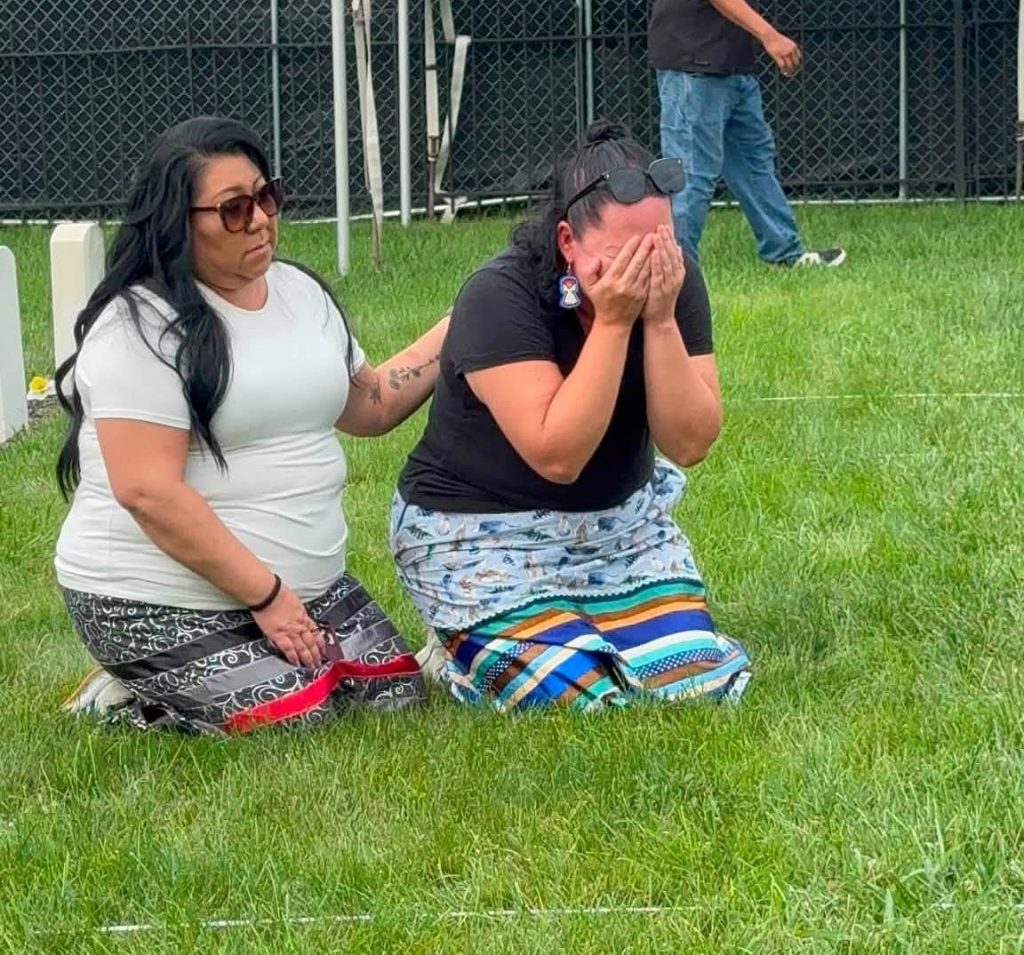
Michael became overwhelmed when she reached Christine’s grave and knelt beside it. Shaye Frank was photographed comforting her.
“Oh gosh. I thought, finally we are here for her,” Michael said following that visit. “She knows we haven’t forgotten her and that we, her family, are here today, resilient and alive despite all the things that was done to us in the name of assimilation.”
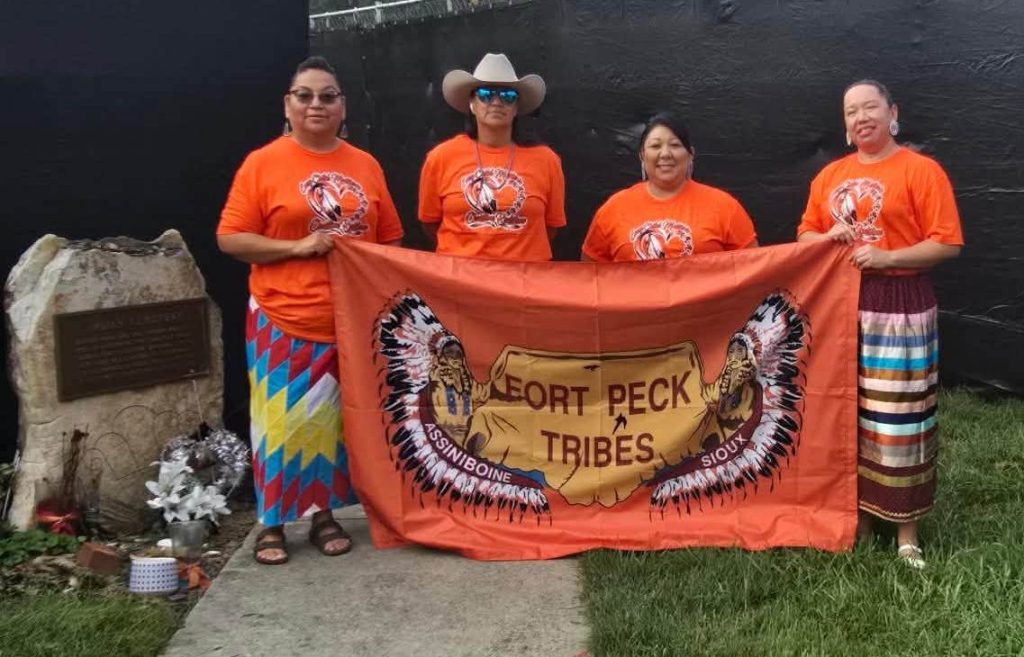
Fort Peck’s traditional blue tribal flag stood at the cemetery alongside a large orange version of the flag. Orange has become an international symbol of remembrance for children who attended residential and boarding schools.
The orange Fort Peck flag was carried to Carlisle as the local Orange Flag Project neared its conclusion. The awareness campaign began July 22 and has kept Christine, Peter and Richard visible through daily displays of Fort Peck’s flag with its blue field changed to orange.
The road home
The three children remain at Carlisle while the forensic work is completed.
A transfer ceremony is scheduled for 8 a.m. Sunday, Sept. 6, with the Fort Peck delegation expected to leave Carlisle at approximately 9 a.m. The procession will travel first to Orland Park, Illinois, and then to Fargo, North Dakota.
On Tuesday, Sept. 8, the children are expected to reach the eastern boundary of the Fort Peck Reservation at Big Muddy Creek. A smudging ceremony will be held before the procession continues to Wolf Point, where custody will be transferred to Clayton Stevenson Memorial Chapel.
For Michael, the homecoming is about more than completing a historical process. It is about returning three people who have always remained part of Fort Peck.
“I am so proud of Fort Peck and proud to be from there,” Michael said. “I am excited to bring her back along with Richard and Peter, and see them be embraced by the love of their people after being so far away for far too long.”




Leave a Reply